

Do your periods come every 40, 50, or even 60 days instead of monthly? You may have oligomenorrhea. It’s a common but often ignored menstrual issue. This guide breaks down the causes, symptoms, diagnosis, and treatment — in plain language.
What Is Oligomenorrhea?
Oligomenorrhea means infrequent periods. Cycles last longer than 35 days. You may get fewer than 9 periods a year. It’s different from having zero periods, which is called amenorrhea.
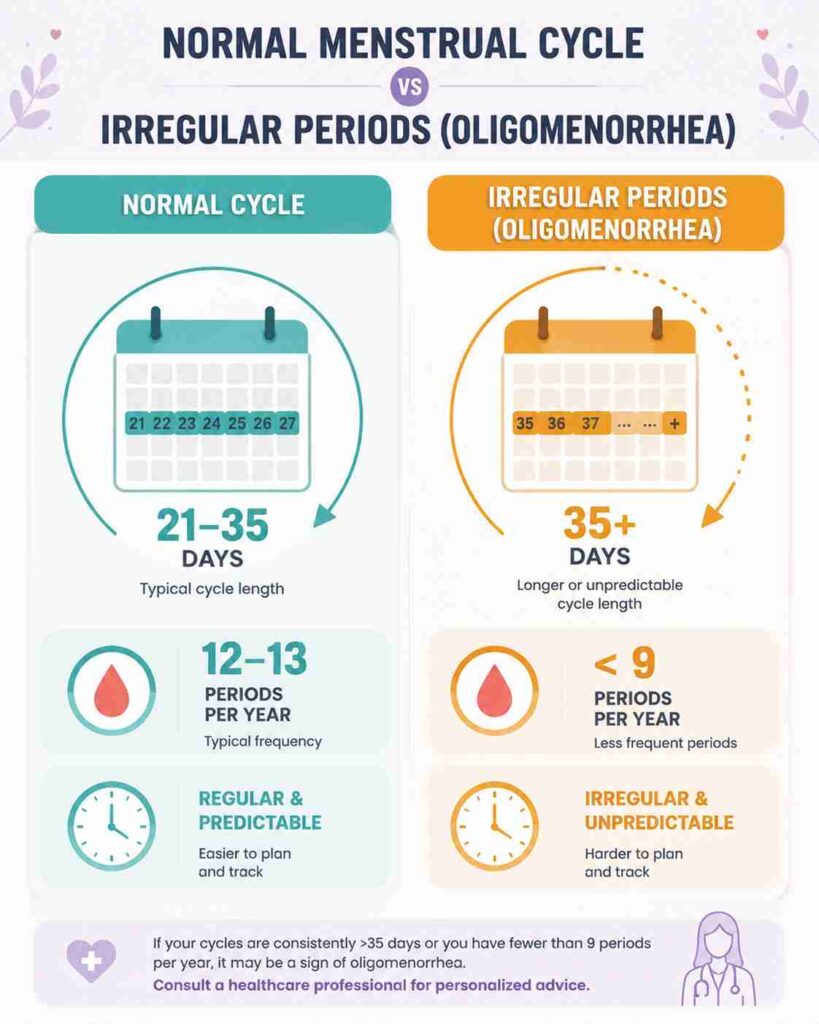
Normal Cycle vs Oligomenorrhea vs Amenorrhea
| Type | Cycle Length | Periods Per Year |
|---|---|---|
| Normal cycle | 21–35 days | 12–13 |
| Oligomenorrhea | 35 days to 6 months | Fewer than 9 |
| Amenorrhea | No period for 3+ months | 0 |
How Common Is Oligomenorrhea (Abnormal Menstruation)?
This isn’t rare. It’s a widely reported issue among women of reproductive age.
| Statistic | Details | Source |
|---|
| Oligomenorrhea prevalence among menstruating females | About 12% to 15% of females who menstruate experience oligomenorrhea at some point in their lives. | Cleveland Clinic |
| General prevalence of menstrual disorders | Menstrual disorder research estimates prevalence at around 13.5% of the population. | NCBI StatPearls |
| Abnormal Menstruation and infertility | Roughly 10% to 20% of women experiencing infertility also have oligomenorrhea/Abnormal Menstruation. | Cleveland Clinic |
| PCOS contribution to oligomenorrhea | PCOS accounts for approximately 4% to 10% of oligomenorrhea cases among women of reproductive age. | NCBI StatPearls |
What Causes Irregular Periods?
Several health conditions can throw off your cycle:
- PCOS (Polycystic Ovary Syndrome): A leading cause. Disrupts hormone levels and ovulation.
- Thyroid disorders: Both an underactive and overactive thyroid can delay periods.
- Hypothalamic dysfunction: Stress, over-exercising, or disordered eating can suppress the hormones that trigger menstruation.
- Premature Ovarian Insufficiency (POI): Early loss of ovarian function before age 40.
- Chronic conditions: Diabetes, obesity, and high blood pressure can all disturb hormonal balance.
- High prolactin levels: Often linked to thyroid issues or a small pituitary tumour (prolactinoma).
Related read: What Are the Causes of Abnormal Menstruation?
Symptoms of Oligomenorrhea You Shouldn’t Ignore
- Periods spaced more than 35 days apart.
- Fewer than 9 periods in a year.
- Complete missed cycles (amenorrhea) for some months.
- Heavier or longer bleeding when periods do occur.
- Trouble conceiving due to irregular ovulation.
Oligomenorrhea vs Amenorrhea: What’s the Difference?
People often confuse the two. Here’s a quick way to tell them apart.
| Feature | Oligomenorrhea | Amenorrhea |
|---|---|---|
| Definition | Infrequent periods | No periods at all |
| Cycle gap | 35 days to 6 months | 3+ months with no period |
| Can progress to | Amenorrhea, if untreated | — |
| Common causes | PCOS, thyroid, stress | Pregnancy, menopause, POI, extreme weight loss |
How Is Oligomenorrhea Diagnosed?
Diagnosis starts with understanding your cycle history, then narrows down the cause.
- Medical history: Cycle pattern, lifestyle, family history, weight changes, hair growth.
- Physical exam: Checks for signs like acne or excess facial hair.
- Blood tests: Prolactin, FSH, thyroid hormones, estrogen, and testosterone levels.
- Ultrasound: Checks the ovaries for cysts, especially if PCOS is suspected.
- Pregnancy test: Rules out pregnancy as the cause of a missed period.
Treatment for Irregular Periods
Treatment depends on the underlying cause.
- Lifestyle changes: Healthy weight, lower stress, moderate exercise can restore regular cycles.
- Hormonal therapy: Common for PCOS-related or hormone-driven irregularity.
- Thyroid treatment: Medication corrects hypo- or hyperthyroidism-linked irregularity.
- Fertility treatment: Ovulation induction helps women trying to conceive.
- Surgery (rare): Ovarian drilling for severe PCOS cases that don’t respond to other treatment.
Can Irregular Periods Affect Fertility?
Yes. Irregular ovulation makes it harder to predict your fertile window. This can delay conception. If you’re trying to get pregnant and your cycles are irregular, get evaluated early rather than waiting.
When Should You See a Gynaecologist?
Book a consultation if you notice:
- Periods consistently more than 35 days apart.
- No period for 3 months or longer.
- Irregular cycles along with acne, excess hair growth, or weight changes.
- Difficulty conceiving after 6–12 months of trying.
This applies to teenagers too. Irregular cycles in the first year or two after your first period are common. But persistent irregularity beyond that should be checked.
Conclusion
Oligomenorrhea is common and usually manageable once diagnosed correctly. Don’t ignore persistent gaps between periods. If your cycles are irregular, consult our doctor for abnormal menstruation treatment.
Related reads: 7 Types of Abnormal Menstruation to Know About | What Causes Changes in Menstrual Cycle? | Painful Periods: Remedies and Treatment Options
FAQs
Is oligomenorrhea normal in teenagers?
Some irregularity is common for the first 2–3 years after the first period. Persistent irregularity after that needs evaluation.
Can stress cause oligomenorrhea?
Yes. Chronic stress affects the hypothalamus, which controls the hormones needed for regular ovulation.
Is oligomenorrhea curable?
It’s often manageable once the underlying cause — like PCOS or thyroid imbalance — is treated.
Does oligomenorrhea mean I can’t get pregnant?
Not necessarily. It can make conception harder due to irregular ovulation, but many women with oligomenorrhea do conceive with the right treatment.
Is PCOS the same as oligomenorrhea?
No. PCOS is a hormonal condition that often causes oligomenorrhea as one of its symptoms.