
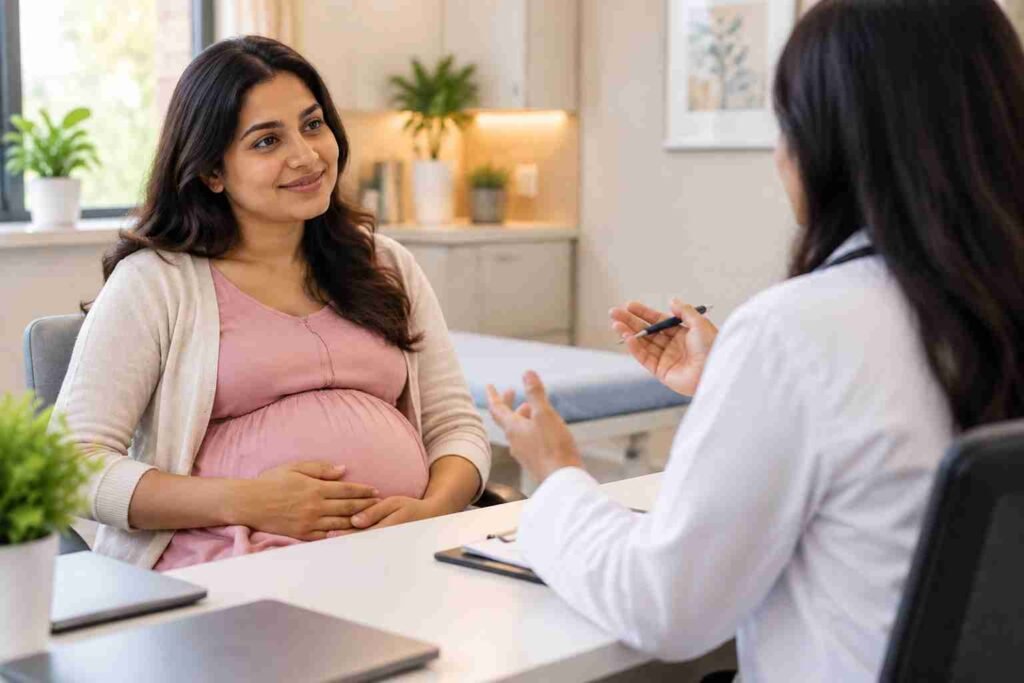
As the due date approaches, one question becomes increasingly important: Should you prepare for a normal delivery or a C-section? Both methods can be safe, but the right choice depends on your pregnancy, your baby’s condition, your medical history, and how labour progresses.
Good pregnancy care includes discussing delivery preferences well before labour begins. However, the final plan may sometimes need to change for the safety of the mother or baby.
Understanding normal delivery vs C-section can help you prepare without unnecessary fear and make informed decisions with your obstetrician.
What Is a Normal (Vaginal) Delivery?
A normal delivery means the baby is born through the vagina, usually after labour begins naturally or is medically induced when required.
One of the main benefits of vaginal delivery is generally faster recovery. Many mothers can start moving around relatively soon after birth and may return to routine activities earlier than after a surgical delivery.
Other potential benefits include:
- No abdominal surgical incision
- Usually a shorter hospital stay
- Faster physical recovery in uncomplicated cases
- Earlier mobility after childbirth
- Lower risk of certain surgery-related complications
Some women worry mainly about labour pain. Pain-relief options, including epidural analgesia when medically suitable and available, can significantly reduce labour pain.
The suitability of these options should always be discussed with the obstetric and anaesthesia team.
What Is a Cesarean (C-Section) Delivery?
A cesarean delivery or C-section is a surgical procedure in which the baby is delivered through incisions in the mother’s abdomen and uterus.
A C-section may be planned before labour or performed because an unexpected situation develops during labour. An elective C-section is scheduled in advance, either because there is a medical indication or, in some circumstances, after detailed discussion of the mother’s preferences, risks and future pregnancy plans.
When discussing cesarean delivery risks and benefits, it is important to remember that a C-section can be lifesaving when vaginal birth poses a significant risk. However, because it is major surgery, potential risks include infection, bleeding, blood clots, anaesthesia-related complications and a longer recovery period.
Normal Delivery vs. C-Section: Key Differences
| Factor | Normal Delivery | C-Section |
| Method | Baby is delivered vaginally | Baby is delivered surgically |
| Anaesthesia | May or may not be required | Usually required |
| Hospital stay | Generally shorter | Generally longer |
| Recovery time | Usually quicker | Usually takes longer |
| Surgical incision | No abdominal incision | Abdominal and uterine incisions |
| Planning | Labour may be less predictable | Planned C-sections offer a scheduled date |
| Future pregnancy | No uterine surgical scar | Uterine scar may affect future delivery planning |
When Is a C-Section Necessary? (Medical Reasons)
If you are wondering when a C-section is needed, the answer depends on whether vaginal birth could create additional risks for the mother, baby or both.
A C-section may be recommended before labour or become necessary when labour does not progress safely. Common reasons include problems with labour progression, concerns about the baby’s heart rate, placenta-related complications, breech presentation and certain maternal medical conditions.
Maternal Health Conditions
Certain maternal conditions can influence the safest method of delivery. These may include:
- Certain heart or neurological conditions
- Placenta previa
- Some serious pregnancy complications
- Certain infections that may affect the baby during vaginal birth
- Previous uterine surgery in specific circumstances
- Complications during a high-risk pregnancy
Having a medical condition does not automatically mean a C-section will be required. Individual assessment remains essential.
Baby-Related Complications
A C-section may also be considered when there are concerns about the baby’s position or wellbeing, such as:
- Breech or certain abnormal positions
- Concerning changes in the baby’s heart rate
- Umbilical cord complications
- Multiple pregnancies
- Labour failing to progress
- Large size of the baby
Can You Have a Normal Delivery After a Previous C-Section?
Yes, some women who previously had a C-section may be suitable for VBAC (vaginal birth after cesarean).

Whether VBAC is appropriate depends on several factors, including the type of uterine incision used during the previous C-section, why the earlier C-section was required, the number of previous C-sections, current pregnancy complications and whether the hospital can provide emergency C-section care if necessary.
A successful VBAC can offer a shorter recovery, avoid another abdominal operation and reduce some complications associated with repeated C-sections. However, there is a rare but serious risk of the previous uterine scar opening during labour.
For this reason, VBAC should be planned after individual assessment rather than assumed to be suitable for everyone.
Myths About Normal Delivery You Should Stop Believing
- Myth: Normal delivery is always unbearably painful
Fact: Labour experiences vary considerably. Epidural analgesia and other pain-management techniques may help reduce discomfort when appropriate.
- Myth: Vaginal birth is always safer than C-section
Fact: Not always. When specific complications occur, a C-section may be the safer delivery method.
- Myth: If labour starts normally, a C-section cannot be required later
Fact: Labour can change. A C-section may become necessary if labour stops progressing or concerns arise about the mother or baby.
Myths About C-Section You Should Stop Believing
- Myth: Having a C-section means you failed at normal delivery
Fact: A C-section is another method of childbirth and can be the safest medical decision in certain situations.
- Myth: One C-section means every future birth must be a C-section
Fact: Some women may be suitable candidates for VBAC after appropriate assessment.
- Myth: A planned C-section has no risks
Fact: Although C-sections are commonly performed and generally safe, they might have some potential short- and long-term risks.
How to Decide What’s Right for You
Choosing between safe delivery options should be a shared decision between you and your obstetrician.
Your doctor may consider your medical history, previous pregnancies, placental position, baby’s growth and position, previous uterine surgery, pregnancy complications and your personal preferences.
Rather than deciding that you must have one particular type of birth, it can be more helpful to create a preferred birth plan along with a safe alternative plan.
If you have specific concerns or a complicated pregnancy, discussing them early with a gynae surgeon can help you understand which options may be suitable and what circumstances could require the delivery plan to change.
Questions to Ask Your Gynaecologist
Before deciding, consider asking:
- Is vaginal delivery medically suitable for your pregnancy?
- Are there any factors that increase your chance of needing a C-section?
- What pain-relief options are available during labour?
- What would make the doctor recommend an emergency C-section?
- How could either delivery method affect future pregnancies?
- If you previously had a C-section, are you suitable for VBAC?
- What should you expect during recovery?
These conversations can help you enter labour feeling informed rather than trying to predict every detail of the birth.
Seek Expert Guidance
As a gynaecologist and obstetrician, I believe the best delivery plan is not simply “normal delivery” or “C-section”—it is the option that protects both mother and baby based on the circumstances of that pregnancy.
If you are searching for a gynaecologist in Salt Lake to discuss your delivery plan, I can assess your pregnancy and help you understand your options. You can book a consultation with me today.
FAQs
- Is normal delivery safer than a C-section?
For many uncomplicated pregnancies, vaginal delivery can be a safe option and usually involves a shorter recovery. However, if certain complications are present, a C-section may be safer for the mother, baby or both. The safest option depends on individual clinical circumstances.
- How long does it take to recover from a C-section compared to normal delivery?
Recovery after an uncomplicated vaginal birth is generally quicker. A C-section involves abdominal surgery, so recovery usually takes several weeks. Some activities may remain uncomfortable for about six weeks, although individual recovery varies.
- Can you choose a normal delivery even if your doctor recommends a C-section?
You should ask your doctor why a C-section is being recommended and discuss the risks and alternatives. If there is a clear medical reason that makes vaginal birth unsafe, attempting it may increase risks for you or your baby. Shared decision-making is important, but safety should guide the final plan.
- Is VBAC (normal delivery after a previous C-section) possible?
Yes. VBAC is possible for many women, but eligibility depends on factors such as the previous uterine incision, reason for the earlier C-section, current pregnancy, and hospital resources.
- Does a C-section leave a permanent scar or affect future pregnancies?
A C-section leaves scars on both the abdomen and uterus. The abdominal scar usually fades over time but does not disappear completely. A uterine scar can influence future pregnancy and delivery planning, and some risks increase with repeated C-sections. This does not necessarily mean future pregnancies will be complicated or that another C-section will always be required.