

“It’s been a year, and every month feels like a new disappointment. We have been trying, hoping, and waiting, but things aren’t working out as planned.”
Many couples face this situation, and it is because fertility and conception can be a long and stressful journey. Whether you’ve been trying to conceive for months or years, understanding the fertility process is the first step toward overcoming challenges.
A gynecologist like Dr. Smita Jadhav can be a guiding light, offering expert advice and personalized care to help you on this journey.
Here we’ll discuss the basics of fertility, common fertility problems, and how a gynecologist can help you navigate this often overwhelming process.
What is Fertility and How Does Conception Happen?
Let’s break it down. Imagine your body as a finely tuned machine. For conception to happen, everything needs to work perfectly.
Here’s a quick rundown of the process:
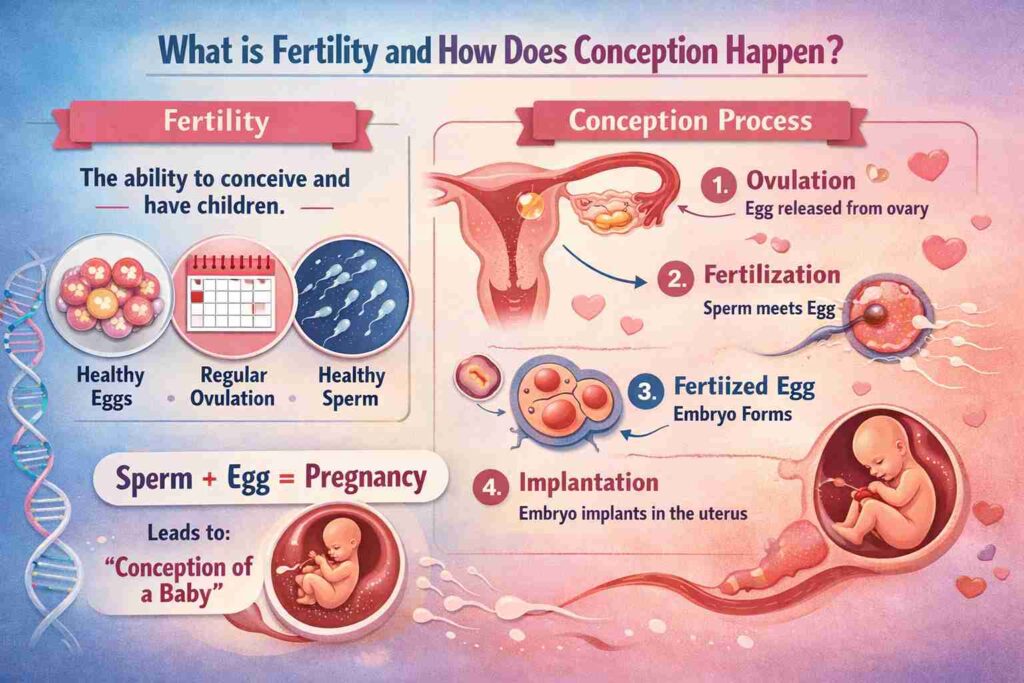
- Ovulation: Each month, a woman’s ovary releases a mature egg into the fallopian tube, which is ready for fertilization.
- Fertilization: When sperm meets the egg in the fallopian tube, fertilization happens, and an embryo is formed.
- Implantation: The fertilized egg travels down to the uterus and attaches itself to the uterine lining, starting pregnancy.
“Simple enough, right?” Well, not always. Fertility isn’t just about biology; it involves physical, emotional, and sometimes environmental factors. And that’s where Dr. Smita Jadhav, a gynecology doctor in Salt Lake, can help you.
When Should You Consult a Gynecologist About Fertility Issues?
“So, how do you know when it’s time to seek help?”
If you’ve been trying to conceive for more than a year without success, it’s time to consult a gynecologist. But there are other signs that you might want to seek help earlier:
- Irregular periods: If your cycles are unpredictable, ovulation may be irregular, making conception harder.
- Frequent miscarriages: Repeated miscarriages are often a sign of underlying fertility problems.
- Pain during intercourse: This could signal conditions like endometriosis, which can affect fertility.
- Known reproductive health conditions: If you have conditions like PCOS or fibroids, they can affect your ability to conceive.
- Age: Women over the age of 35 may experience a decline in fertility and should consider seeking guidance earlier.
Don’t wait too long. If any of these signs sound familiar, it’s time to speak to a gynecologist. They can give you the answers you need.
How Can a Gynecologist Help You Understand Fertility?
So, what exactly does a gynecologist do when it comes to fertility? Here’s a rundown of how they can guide you:
- Thorough Reproductive Health Evaluation
When you meet your gynecologist, they’ll start by understanding your menstrual cycle and overall health. They’ll ask about your regularity, your symptoms (pain, heavy bleeding), and your medical history. “Have you experienced any hormonal imbalances, or do you have a family history of fertility issues?” they might ask. - Fertility Testing
Your gynecologist will recommend several tests to get a clear picture of your fertility. Here’s what could be involved:
- Blood tests to check hormonal levels (like FSH, LH, AMH) that affect fertility.
- Ultrasound scans to check for ovarian cysts, fibroids, or other reproductive health issues.
- HSG (Hysterosalpingography) to check if your fallopian tubes are open.
- Blood tests to check hormonal levels (like FSH, LH, AMH) that affect fertility.
- Personalized Treatment Plans
Once they have the results, they’ll create a plan that works for you. The doctor recommends, “If your ovulation is irregular, we’ll try ovulation-inducing medications like Clomid (an oral prescription fertility medication)”. Depending on your diagnosis, they might suggest IUI (Intrauterine Insemination) or IVF (In Vitro Fertilization). - Male Factor Infertility
Fertility isn’t just about women. If male infertility is suspected, the doctor may suggest sperm analysis or refer you to a fertility specialist. “We’ll take a look at sperm count and quality, which are crucial for conception,” they explain.
Common Fertility Issues That May Require Medical Attention
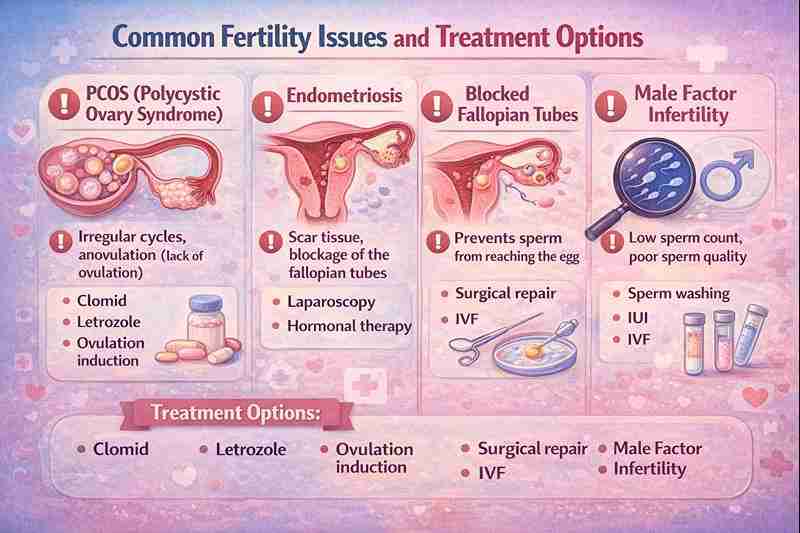
It’s important to understand common fertility issues so you can address them with your gynecologist. Some of these issues are more common than you might think.
Here’s a table that outlines some of the common conditions:
| Condition | Impact on Fertility | Possible Treatment |
| PCOS (Polycystic Ovary Syndrome) | Irregular cycles, anovulation (lack of ovulation) | Clomid, Letrozole, Ovulation induction |
| Endometriosis | Scar tissue, blockage of the fallopian tubes | Laparoscopy, Hormonal therapy |
| Blocked Fallopian Tubes | Prevents sperm from reaching the egg | Surgical repair, IVF |
| Male Factor Infertility | Low sperm count, poor sperm quality | Sperm washing, IUI, IVF |
How to Prepare for Your First Visit to the Gynecologist
Your first appointment with a gynecology doctor in Salt Lake doesn’t need to be intimidating. “We’ll guide you through the process,” your doctor reassures you.
Here’s how to prepare:
- Track Your Menstrual Cycle
Keep track of your cycle length, flow, and any symptoms (pain, mood swings). “It helps us understand your pattern,” your doctor says. - List Your Medications
Bring a list of any medications or supplements you’re taking. “Some medications can affect fertility, so it’s important for us to know,” your doctor explains. - Discuss Your Family History
“Any history of thyroid problems, diabetes, or other health issues?” your doctor will ask. Family history is an important factor in fertility. - Be Honest About Your Concerns
Don’t be afraid to ask questions. “The more open you are, the better we can help,” says your doctor. They are there to guide you with empathy.
Fertility Treatment Options: What Are Your Choices?
So, what options do you have if you need help conceiving?
Let’s take a look at some common fertility treatments that your gynecologist might recommend:
Ovulation Induction
Ovulation induction is a treatment used to stimulate the ovaries to release eggs. For women who don’t ovulate regularly, medications like Clomid are commonly prescribed. These medications help regulate ovulation, making it easier to time conception.
Intrauterine Insemination (IUI)
Intrauterine insemination (IUI) is a fertility treatment where sperm is directly placed into a woman’s uterus around the time of ovulation. This procedure increases the chances of fertilization by bringing sperm closer to the egg. It’s commonly used for mild infertility issues.
In Vitro Fertilization (IVF)
In Vitro Fertilization (IVF) is a complex fertility treatment in which eggs are fertilized outside the body in a lab. Once the embryos are created, they are implanted into the uterus for potential pregnancy. IVF is often recommended when other fertility treatments, like IUI, fail.
Egg Freezing
Egg freezing, also known as oocyte cryopreservation, is a process where a woman’s eggs are collected and frozen for future use. This is a viable option for women who wish to delay pregnancy due to career or health reasons. When ready, the frozen eggs can be unfrozen and fertilized for conception.
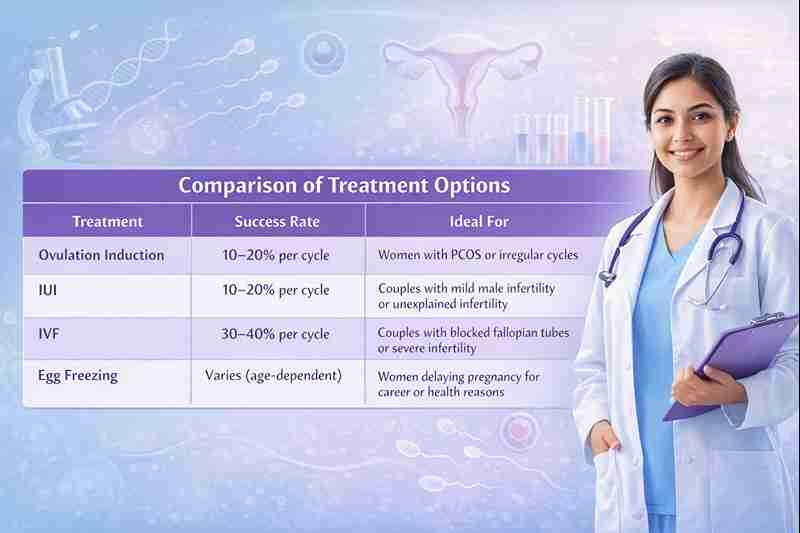
Comparison of Treatment Options
This table will help you understand the effects and success rate of treatment options:
Lifestyle Changes to Boost Fertility
Along with medical treatments, simple lifestyle changes can significantly impact fertility.
Here are some tips to improve your chances:
- Maintain a Healthy Weight
Being overweight or underweight can disrupt your menstrual cycles and affect ovulation. - Eat a Balanced Diet
Focus on foods rich in folic acid, vitamins, and minerals to support fertility. - Exercise Regularly
Aim for moderate exercise, which helps maintain hormone balance. - Avoid Smoking and Alcohol
Smoking and excessive alcohol intake can impair fertility in both men and women. - Manage Stress
High stress levels can affect your hormonal balance. Try yoga or meditation to relax.
Take Charge of Your Fertility with Professional Help
Fertility treatments can seem overwhelming, but with the right guidance, you’re never alone in your journey. Whether you’re considering IUI, IVF, or egg freezing, a skilled gynecologist offers the support and expertise you need. Taking the first step toward understanding and addressing fertility challenges is crucial.
Don’t wait any longer, reach out today to schedule your appointment. Call Dr. Smita Jadhav, a gynecology doctor in Salt Lake, at +91 97488 25624 today.
People Also Ask (FAQs)
How can a gynecologist help with fertility?
A gynecologist performs tests, identifies issues, and recommends treatments like IUI and IVF.
What are the common causes of infertility in women?
Conditions like PCOS, endometriosis, and blocked fallopian tubes are common causes of infertility.
What fertility tests will a gynecologist recommend?Tests include blood work, ultrasound scans, and HSG to check reproductive health.