
Are you thinking about birth control pills but unsure about the benefits and drawbacks? This guide covers how the pill works, who it suits, what side effects to expect, and the questions patients ask most often.
Quick answer: Birth control pills are daily hormonal tablets that prevent pregnancy, mainly by stopping ovulation. Many women also use them to ease painful periods, heavy bleeding, acne, PMS and PCOS symptoms. They do not protect against STIs, and they are not right for everyone, so a check-up with your gynaecologist comes first.
Key Takeaways
a. The pill is highly effective when taken correctly and on time.
b. It can also help with cramps, heavy periods, anaemia, PMS, acne and PCOS symptoms.
c. Most side effects are mild and often improve over time.
d. Serious risks such as blood clots are very rare, but some women should avoid the combined pill.
e. Only condoms protect against STIs.
How Effective Are Birth Control Pills? (What the Data Says)
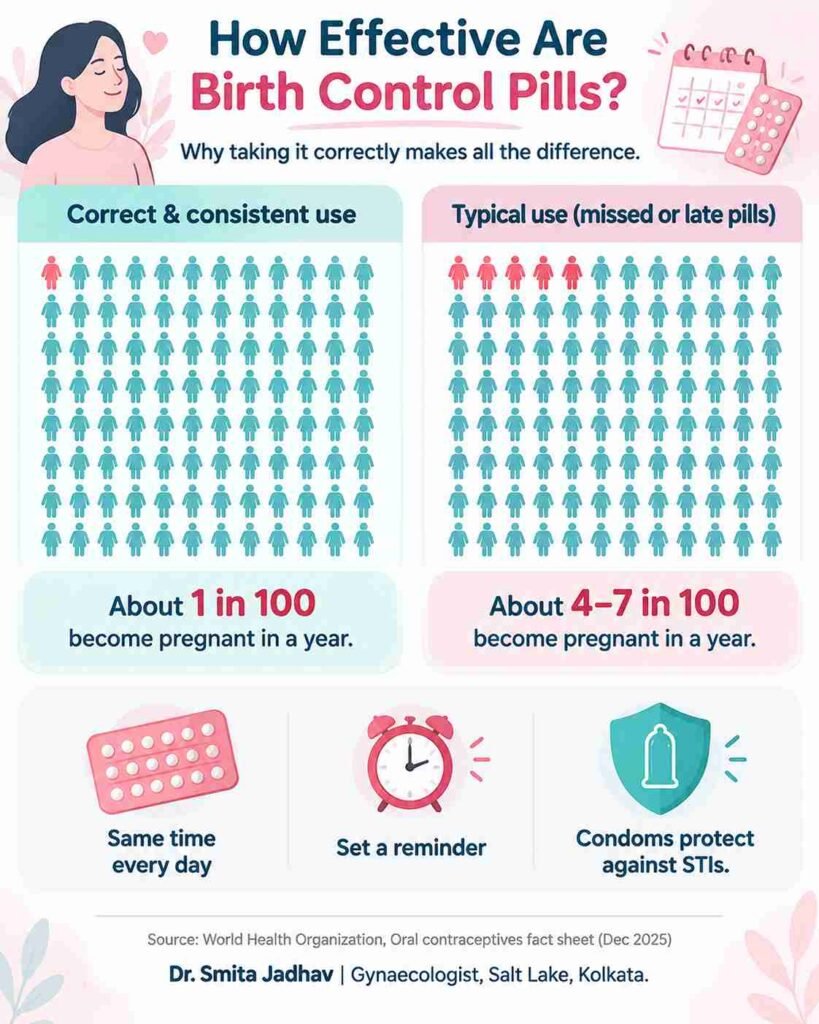
WHO reports that with typical use, about 4 to 7 in every 100 women using the pill become pregnant in a year. With correct, consistent use, only about 1 in 100 does.
The gap between those numbers is missed or late pills. That is why sticking to your schedule matters.
Types of Birth Control Pills
| Feature | Combined pill (COC) | Progestin-only pill (mini-pill) |
| What it contains | Oestrogen + progestin | Progestin only |
| Main action | Prevents ovulation | Thickens cervical mucus; also disrupts ovulation |
| Timing sensitivity | Take daily at the same time | Very strict; delays of more than a few hours can reduce protection |
| Breastfeeding | Start 6 weeks after birth if partially breastfeeding, or after 6 months if fully breastfeeding | Safe while breastfeeding; does not reduce milk supply |
| Oestrogen-related risks | Yes (very rare) | No, suitable for women who cannot take oestrogen |
Benefits of Birth Control Pills
- Convenient and Effective Pregnancy Prevention
The pill is a simple, reversible method you control yourself. Take it at the same time daily and start each new pack on schedule. Add condoms if you need protection against STIs.
- Health Benefits Beyond Contraception
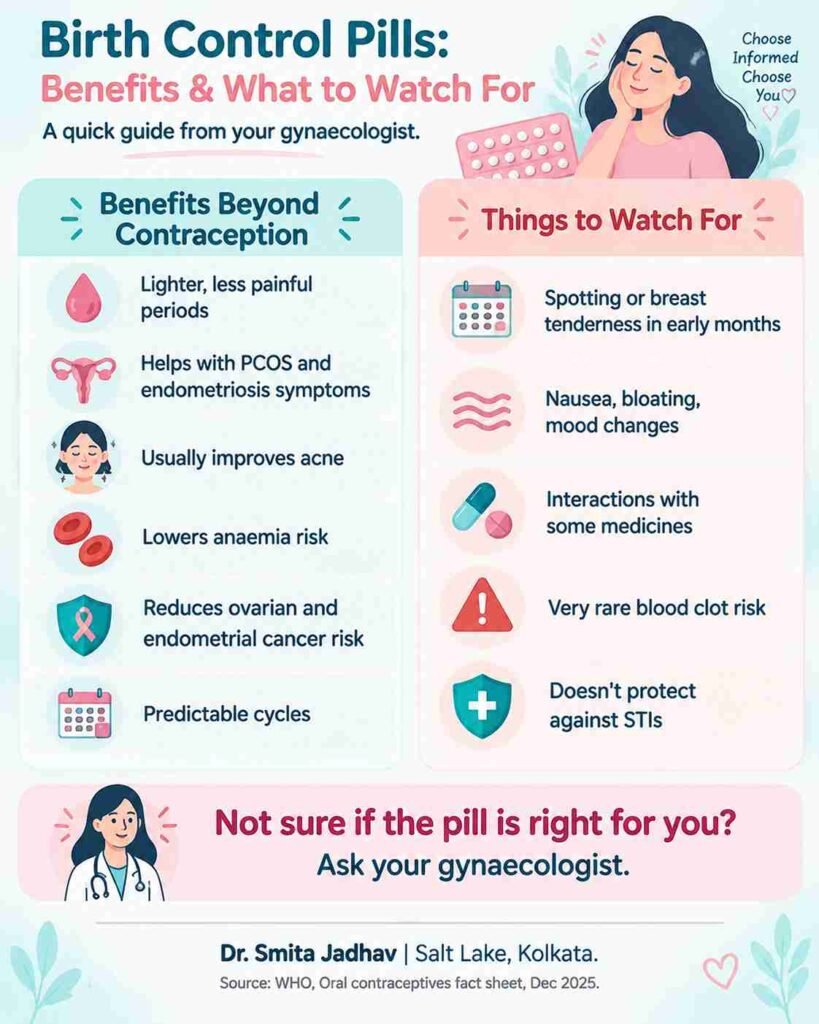
The pill can help reduce the risk of uterine and ovarian cancer, anaemia, menstrual cramps, menstrual bleeding problems, ovulation pain, and symptoms of PCOS and endometriosis.
| Concern | How the pill may help |
| Painful periods | Reduces menstrual cramps |
| Heavy periods | Lightens bleeding and lowers the risk of anaemia |
| Acne | Usually improves, though it can occasionally worsen |
| PMS | Can lessen symptoms |
| PCOS and endometriosis | Helps manage symptoms |
| Ovarian and endometrial cancer | Risk falls the longer the pill is used |
| Ectopic pregnancy | Lowers the risk by preventing ovulation |
- A Regular, Predictable Cycle
Many women choose the pill because it makes periods regular and predictable. Some women skip periods for a special occasion, but this should only be done on your gynaecologist’s advice.
- Fertility Returns Quickly
WHO states that fertility returns quickly after stopping the pill, with no delay. The pill does not cause infertility. Your periods may take a few months to settle back into their pre-pill pattern.
Disadvantages and Risks of Birth Control Pills
- Daily Discipline
Missed or late pills lower effectiveness. If you often forget, talk to your doctor about a method that needs less daily effort, such as an implant, injection or IUD.
- Common Side Effects
Some women notice changes in bleeding, headaches, dizziness, nausea, mood changes or breast tenderness. WHO notes these are not harmful and often improve over time.
| Side effect | What to know |
| Spotting between periods | Common in the first few months |
| Nausea | Often settles; try taking the pill with food or at bedtime |
| Breast tenderness | Usually mild and temporary |
| Bloating or water retention | Ask about a different formulation if it persists |
| Mood changes or low mood | Tell your doctor promptly, especially if you feel persistently low |
| Reduced libido | Talk to your doctor; a different pill may help |
| Headaches | Report new or severe headaches, especially with visual changes |
If a side effect bothers you after 2–3 months, don’t quit on your own. Switching to a different pill or method often solves it.
- Rare but Serious Risks
Blood clots, stroke and heart attack are very rare with the pill. The mini-pill does not carry these oestrogen-related risks.
who
The pill has a mixed relationship with cancer. It protects against ovarian and endometrial cancer, but users have a higher risk of cervical cancer. Most women have no increased breast cancer risk, though women with BRCA1 or BRCA2 mutations may be at higher risk, especially with long-term use. This is why regular cervical screening and a personalised risk discussion matter.
who
- Medicine and Supplement Interactions
Some medicines can make the pill less effective, including certain anticonvulsants, some antibiotics (such as rifampicin), HIV medications and the herbal supplement St John’s wort. Always tell your gynaecologist about everything you take.
Who Should Talk to a Doctor Before Starting the Pill?
Ask your gynaecologist first if you:
- Smoke, especially if you are over 35
- Have a history of blood clots, stroke or heart disease
- Get migraines with aura
- Have high blood pressure
- Have a personal or family history of breast cancer
- Are breastfeeding
- Take regular medicines or supplements
WHO says most women can use oral contraceptives safely, including adolescents, women over 40 and women living with HIV, but each woman should be assessed by a health professional.
Pill vs Other Contraception: At a Glance
| Method | Daily action needed? | Protects against STIs? | Hormone-free option? |
| Combined pill | Yes | No | No |
| Mini-pill | Yes | No | No |
| Male condom | Each time | Yes | Yes |
| Copper IUD | No | No | Yes |
| Hormonal IUD | No | No | No |
| Implant / injection | No | No | No |
Ready to Choose the Right Contraception?
The best method is the one that fits your health, lifestyle and future plans. Book a consultation with Dr. Smita Jadhav, gynaecologist and gyne surgeon in Salt Lake, Kolkata, for personalised advice.
Disclaimer: This article is for general education and does not replace medical advice. Please consult your gynaecologist before starting, stopping or changing any contraceptive. [Source: WHO, Oral contraceptives fact sheet, Dec 2025]
Frequently Asked Questions About Birth Control Pills
Are birth control pills safe?
For most women, yes. They can be used safely for many years, including by adolescents, under a doctor’s guidance. A medical history check decides which pill is right for you.
who
What should I do if I miss a pill?
Take it as soon as you remember. If you missed more than one, or you are on the mini-pill, contact your gynaecologist, as you may need backup protection such as condoms.
How long does the pill take to work?
Timing depends on when in your cycle you start. Many women need condoms as backup for the first 7 days. Your doctor will confirm this for your pill.
Do birth control pills cause weight gain?
Some women notice temporary bloating or water retention. If it persists, ask about a different formulation.
Can the pill cause infertility?
No. WHO states that oral contraceptives do not cause infertility or birth defects.
Do I need to take a break from the pill?
No. WHO says there is no need for a “rest” from taking the pill.
How soon can I get pregnant after stopping?
Fertility returns quickly after stopping. Pregnancy is possible right away, even if your cycle takes a few months to settle.
Can the pill help with PCOS, acne or painful periods?
Yes. It can ease PCOS symptoms, cramps and heavy bleeding, and acne usually improves. It manages these symptoms but does not cure the underlying condition.
Does the pill protect against STIs?
No. Neither pill type protects against STIs, including HIV, so use condoms if you are at risk.
Can I take the pill while breastfeeding?
The mini-pill is safe while breastfeeding. The combined pill is usually started later, as above.
Which birth control pill is best for me?
There is no single best pill. The right choice depends on your age, health history, cycle, and goals such as acne control, PCOS management or breastfeeding. A consultation is the safest way to decide.